Emergency & panic doors
We retrofit, maintain, repair and inspect escape routes in accordance with EN 179 and EN 1125
Escape and rescue routes for your safety
Escape and rescue route systems only offer real safety if all components are matched to the building and work together reliably. That is why we offer complete solutions from a single source: from the escape door lock to the complex overall system. We convert, maintain, repair and inspect.
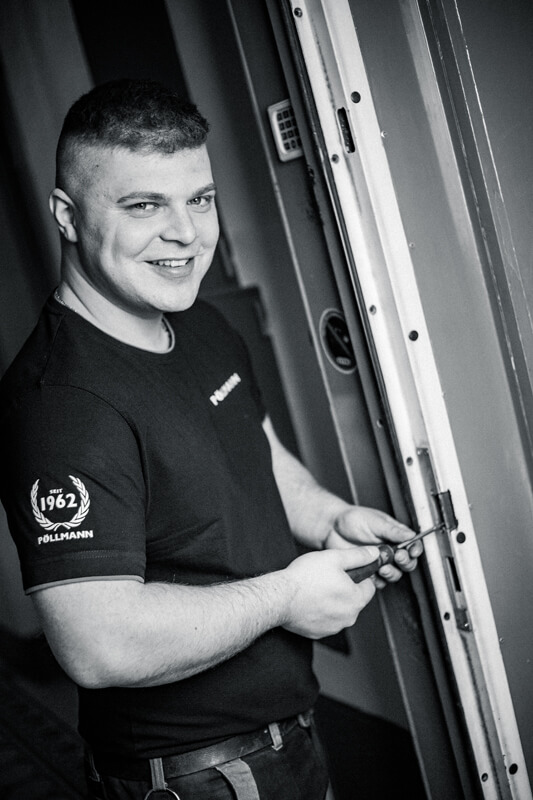
Getting out of a building quickly and safely in an emergency can save lives. Escape routes and rescue routes must therefore be professionally planned and technically equipped. Besides working emergency lighting, two standards take centre stage:
- ÖNORM EN 179 for emergency exit devices with lever handle or push pad
- ÖNORM EN 1125 for panic exit devices with a horizontal push bar
They apply to public buildings, administrative and office complexes just as much as to businesses and private residential complexes. Which standard and equipment are needed in each case depends on the building, the group of users and the approved design. We therefore inspect existing systems on site and document the necessary measures.
Protecting life and property properly
People react very differently to danger. Only a few stay calm; most panic and no longer act rationally. What matters, therefore, is who uses the building: people familiar with the place know their surroundings and find their way outside more easily, while people unfamiliar with it are more likely to panic.
The number of people and how often they change also play a role. It makes a big difference whether five employees have to leave a ground-floor office or hundreds, perhaps thousands, of customers have to leave a shopping centre.
Property can be replaced, human lives cannot.
Guidelines for escape and rescue routes
- Layout and dimensions of escape routes
- Structural and technical design of escape routes
- Signage of escape routes
- Safety lighting of escape routes
- Drawing up escape and rescue route plans
Making escape routes safer
The risk assessment also takes tampering and negligent behaviour into account – think of the emergency exit blocked by parked cars. Escape doors are also often misused, for example to let unauthorised people in or to commit crimes.
A key focus is therefore on securing escape doors and rescue routes against deliberate and unwitting misuse. For this we use special escape-route technology: it protects escape routes against uncontrolled entry and exit and still allows unhindered escape in an emergency. This includes, for example, door guards that report acoustically or via an alarm system when an exit is opened.
Expert advice on everything around the door
Whether it is a simple emergency exit, electromechanical locking or complex escape-route technology – we advise you.
Standards, guidelines and laws
- Building permit (Baubescheid) or escape-route concept
- Arbeitsstättenverordnung (AStV, Austrian Workplace Ordinance), see Arbeitsinspektion: Fluchtwege und Notausgänge (Labour Inspectorate: escape routes and emergency exits)
- OIB guidelines (Austrian Institute of Construction Engineering), in particular OIB Guideline 4
- ÖNORM EN 179 for emergency exit devices with lever handle or push pad
- DIN EN 13637 for electrically controlled exit systems
- ÖNORM EN 1125 for panic exit devices with a horizontal push bar
- DIN EN 13633 for electrically controlled panic exit systems
Emergency exit to EN 179 or panic door to EN 1125?
Put simply: where no panic is to be expected, emergency exit devices to EN 179 are used. Where panic is likely, panic exit devices to EN 1125 are required.
-
Situation
- Emergency exit to EN 179
- no panic to be expected
- Panic door to EN 1125
- panic to be expected
-
Users
- Emergency exit to EN 179
- know the building and the escape doors
- Panic door to EN 1125
- also people unfamiliar with the building and large numbers of people
-
Typical buildings
- Emergency exit to EN 179
- non-public buildings
- Panic door to EN 1125
- hospitals, care homes, public authorities, shopping centres, railway stations, airports, cinemas
-
Operation
- Emergency exit to EN 179
- standardised lever handle or push pad
- Panic door to EN 1125
- horizontal push bar (panic bar)
-
Electrically controlled
- Emergency exit to EN 179
- DIN EN 13637
- Panic door to EN 1125
- DIN EN 13633
With both, the door can be opened from the inside at any time with a single action, whether it is locked or not. Panic doors always open in the direction of escape: a crowd pushing towards the exit in panic thus pushes the door open instead of crushing the people at the front.
Does an escape door have to be equipped to EN 179 or EN 1125?
Not sure which solution fits?
We advise you personally and select components to suit the property and how it is used.
- Master workshop since 1962
- Installation and service
- One point of contact