Maintenance of fire doors and hold-open systems
We maintain, repair and inspect your fire doors, fire gates and hold-open systems
No fire protection without maintenance
Fire doors play a central role in preventive fire protection. They delay the spread of fire and smoke through openings in fire-retardant or fire-resistant walls, that is, at the boundaries between fire compartments, and so keep escape and rescue routes usable.
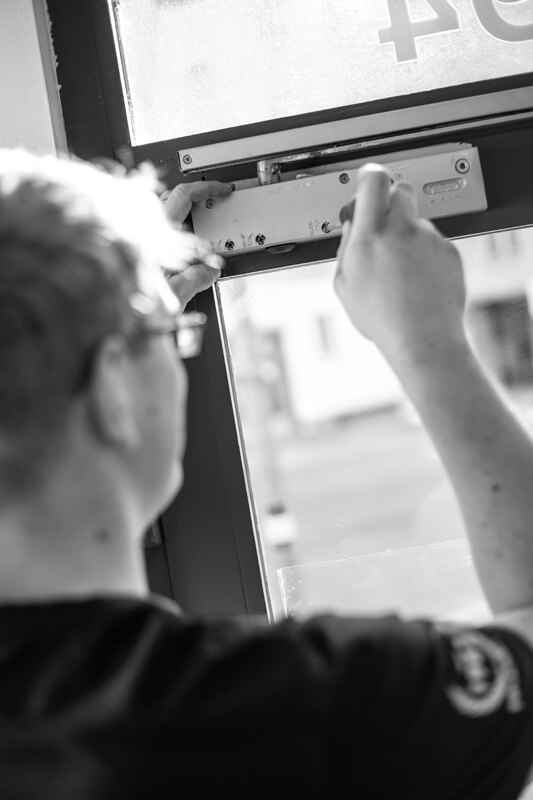
That makes it all the more important for these fire-resisting closures to work reliably. Fire doors and fire gates must therefore be maintained and inspected every twelve months by a certified competent person – by us, for example. Here you can read how maintenance works, what makes a good inspector and why quality pays off.
Regulations on maintaining fire-resisting closures
Fire forgives no mistakes, not even the smallest. Even a minor defect can have devastating consequences in a fire. That is why the building regulations and the relevant guidelines specify where fire doors must be installed and in which technical design.
Fire forgives no mistakes.
In many cases these are elements of class EI₂ 30-C, meaning, among other things, 30 minutes of fire resistance. You will find this or a similar designation on the ÜA plate (Austrian conformity mark) in the door rebate.
Fire-resisting closures – fire doors, fire gates, smoke doors and the associated hold-open systems – prevent a fire from spreading between the fire compartments of a building. In this way they save lives and property. To do so, they must be installed as intended, close properly and seal tightly. That is exactly what we check during the annual maintenance.
Annual inspection is mandatory
During the annual maintenance, we establish whether the fire-resisting closure works correctly. We fix minor defects such as dirt straight away. If we find major defects, a repair is necessary, for which you receive a separate quote.
So regular maintenance does not only serve safety, it also saves money: if defects are detected and fixed early, you are often spared more expensive repairs.
Request a maintenance quote
We maintain, repair and inspect your fire doors, fire gates and hold-open systems. Request a free maintenance quote now.
Standards, guidelines and laws
- Manufacturer's specifications for installation, care and maintenance
- ArbeitnehmerInnenschutzgesetz (ASchG, Austrian Employee Protection Act)
- Arbeitsstättenverordnung (AStV, Austrian Workplace Ordinance)
- Arbeitsmittelverordnung (AM-VO, Austrian Work Equipment Ordinance)
- TRVB B 148 Hold-open systems
- TRVB O 121 Fire protection plans
- ÖNORM B 3850 Fire-resisting closures: hinged and swing doors and gates
- ÖNORM B 3852 Fire-resisting closures: lifting, tilting, sliding and folding doors and gates
- ÖNORM EN 14637 Building hardware – Electrically controlled hold-open systems for fire/smoke door assemblies – Requirements, test methods, application and maintenance
- OIB guidelines (Austrian Institute of Construction Engineering), in particular OIB Guideline 4
Operator responsibility
Ensuring that fire doors and fire gates work properly is the operator's responsibility. All employees and users should know that fire doors must never be obstructed, wedged or held open in any other way. Clearly visible signs on the doors make this clear.
Once a month, the company's own fire protection officer checks that the hold-open system works (keyword: release button) and records this in the fire protection log (Brandschutzbuch). Professional maintenance and inspection of the hold-open system takes place annually together with the fire door, carried out by a competent person with the appropriate proof of qualification.
What makes a competent person
First of all, he or she needs proof of qualification as a certified competent person for fire and smoke doors. Thorough maintenance also requires a great deal of expertise and product knowledge and experience with doors, gates, locks and fittings. When choosing your service provider, rely on certified master locksmith businesses rather than general facility management providers. As such a business, we offer you:
- Knowledgeable, expert technicians Master locksmiths certified as competent persons who are familiar with the relevant standards, laws and technical guidelines.
- Long-standing experience Doors, gates and everything that goes with them are our daily bread. That is why we spot and fix problems before they lead to damage.
- Manufacturer independence We know the fire doors and fire gates of all well-known manufacturers and inspect all your fire-resisting closures independently.
- Continuity and reliability As a family business, we offer you the same contacts for the long term, who know your fire-resisting closures personally.
How to prepare for the maintenance
How fire doors, fire gates and hold-open systems are to be maintained is set out in the manufacturer's maintenance instructions. The operator receives them after installation, together with other documents to keep. Keep these documents to hand. If they are missing, obtain them in good time from the supplier, the construction company, the general contractor or the previous owner.
For a suitable quote, we need a list of your fire-resisting closures. For each one, note:
- whether it is a door or a gate
- for doors, whether it is single- or double-leaf
- whether there is a hold-open system
How the maintenance works
Typical defects on fire doors are dirt, being painted over afterwards, posters or notes stuck on them and the classic: the wedge holding the door open. That is an absolute no-go.
-
Remove the wedge and clean
We remove the wedge – sometimes also a bin, a chair or a screwdriver – and give the fittings a rough clean: lock, cylinder, strike plate, hinges and door closer. -
Check closing and seals
We check whether the door closes correctly from every opening angle, whether door and floor seals are present and in good order, whether the gap dimensions are right and whether any intumescent strip is intact. -
Check the hold-open system
First we clarify whether the hold-open system meets the normative requirements, that is, whether it may be installed at all. Then we check the hold-open function, the associated fire detector (also called a smoke detector), the power supply and the release device. -
Small repairs straight away
We tighten a loose strike plate and adjust a door closer on the spot. For larger repairs you receive a quote. -
Inspection report and inspection plate
Finally, you receive an inspection report for your records. Once the inspection has been passed, we attach a new, consecutively numbered inspection plate to the door or gate.
Not sure which solution fits?
We advise you personally and select components to suit the property and how it is used.
- Master workshop since 1962
- Installation and service
- One point of contact